


A CPA Comfort Letter is one of the most misunderstood documents in professional accounting. Many clients assume it functions like a certification, guarantee, or approval. In reality, a comfort letter is defined as much by its limitations as by its content. Understanding its scope, boundaries, and purpose is essential, especially for business owners who already rely on documents such as a CPA Letter for Business Owners for loans, leases, or financial reviews.
This article explains what a CPA comfort letter actually is, what it can and cannot say, and why professional boundaries are not optional, but required.
What Is a CPA Comfort Letter?
A CPA Comfort Letter is a written communication issued by a CPA to provide limited, factual information based on specific procedures agreed upon in advance. It is not an audit, review, or assurance report. Instead, it offers “comfort” by confirming certain information without guaranteeing accuracy or outcomes.
Comfort letters are typically requested by lenders, investors, attorneys, or counterparties who want professional context, but not a formal opinion.
Why Comfort Letters Exist
The primary purpose of a CPA comfort letter is to:
- Clarify specific financial facts
- Reduce uncertainty for third parties
- Maintain strict professional boundaries
Unlike broader CPA letters, comfort letters are intentionally narrow. This protects both the CPA and the recipient from relying on information beyond its intended use.
The Foundation: Engagement and Authorization
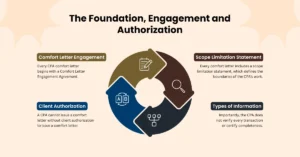
Comfort Letter Engagement Agreement
Every CPA comfort letter begins with a Comfort Letter Engagement Agreement. This document defines:
- The exact procedures the CPA will perform
- The information that may be referenced
- What the CPA explicitly will not do
Without this agreement, issuing a comfort letter would violate professional standards.
Client Authorization to Issue Comfort Letter
A CPA cannot issue a comfort letter without client authorization to issue a comfort letter. This authorization confirms:
- Who may receive the letter
- The specific purpose of the letter
- Restrictions on reuse or redistribution
This ensures the letter is not taken out of context.
Scope: What a CPA Comfort Letter Can Cover
Scope Limitation Statement
Every comfort letter includes a scope limitation statement, which defines the boundaries of the CPA’s work. This typically explains that:
- No audit or review was performed
- No assurance is provided
- The CPA relied on specific records or representations
This statement is not a disclaimer for convenience, it is a professional requirement.
Types of Information Commonly Referenced
A CPA comfort letter may reference:
- Interim financial statements
- Unaudited financial statements
- Selected financial data
Importantly, the CPA does not verify every transaction or certify completeness. The information is presented as reported, not as guaranteed.
Management’s Role in a Comfort Letter
Management Acknowledgment
A key component of a comfort letter is management acknowledgment. Management confirms that:
- The information provided is accurate to their knowledge
- Financial data was prepared in accordance with applicable practices
- Responsibility for the information rests with management—not the CPA
This acknowledgment is critical to maintaining professional boundaries.
What a CPA Comfort Letter Does NOT Do
No Guarantees of Accuracy
A CPA comfort letter never provides guarantees of accuracy. Any request for absolute confirmation, certification, or validation exceeds the scope of a comfort letter.
No Statements of Financial Condition or Viability
A comfort letter does not issue statements of financial strength, solvency, or future performance. These determinations belong to lenders, investors, or other decision-makers.
Tax Documents and Comfort Letters
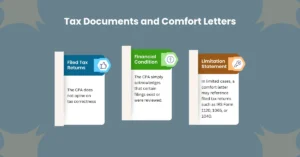
Use of Filed Tax Returns
In limited cases, a comfort letter may reference filed tax returns such as IRS Form 1120, 1065, or 1040. However:
- The CPA does not opine on tax correctness
- No assurance is given regarding IRS acceptance
- The letter does not reduce audit risk
The CPA simply acknowledges that certain filings exist or were reviewed.
CPA Comfort Letter vs Other CPA Letters
How It Differs From a CPA Letter for Business Owners
A CPA Letter for Business Owners typically explains income, expenses, and ownership structure in broader terms. A comfort letter, by contrast:
- Covers a narrower scope
- Avoids interpretive language
- Focuses on specific agreed-upon facts
Understanding this distinction prevents unrealistic expectations.
Professional Boundaries Are Non-Negotiable
CPAs are bound by ethical and professional standards that strictly limit what can be communicated. Comfort letters exist precisely because:
- Third parties want information
- CPAs must avoid assurance
- Liability and misuse must be controlled
The boundaries protect everyone involved.
EEAT Perspective: Why Comfort Letters Still Carry Value
From an EEAT standpoint, CPA comfort letters demonstrate:
- Experience through professional judgment
- Expertise in defining scope and limitations
- Authoritativeness via adherence to standards
- Trustworthiness through transparency and restraint
A document that clearly states what it does not do is often more trustworthy than one that overreaches.
Common Situations Where Comfort Letters Are Requested
Typical Use Cases
- Financing or investment transactions
- Legal or contractual confirmations
- Interim reporting situations
- Due diligence with limited scope
In each case, clarity matters more than breadth.




