


When mortgage income is tied to a business, especially for owners, partners, or self-employed borrowers, underwriters must answer a fundamental question: Is the business stable enough to support the mortgage? A CPA Letter for Mortgage Business Stability exists to address that question with professional context grounded in historical facts, not promises.
This article explains how lenders read these letters, what information they expect, and how a business-stability letter complements a CPA Letter for Mortgage Non-QM when alternative income or bank-statement programs are used.
What Is a CPA Letter for Mortgage Business Stability?
A CPA Letter for Mortgage Business Stability is a non-attest, explanatory letter prepared by a licensed accountant at the borrower’s request. Its purpose is to describe the continuity, structure, and operational resilience of a business based on records reviewed for a defined period.
It does not:
- Audit or verify financial statements
- Guarantee future performance
- Replace lender underwriting
Instead, it provides context, the kind underwriters need to interpret business-derived income responsibly.
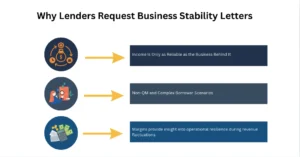
Why Lenders Request Business Stability Letters
Income Is Only as Reliable as the Business Behind It
Even strong historical income can be risky if the business lacks continuity, concentration is high, or margins are volatile. Lenders request a stability letter to understand those dynamics.
Non-QM and Complex Borrower Scenarios
For bank-statement and alternative programs, a CPA Letter for Mortgage Non-QM may explain income mechanics, while a stability letter explains enterprise durability.
Business Identification and Structure
Legal and Trade Identification
A compliant letter typically identifies:
- Enterprise Legal Title
- Trade or DBA Name (if applicable)
- Organizational Structure Type (Sole Proprietorship, LLC, S-Corp, C-Corp, Partnership)
Location and Operations
- Primary Business Location
- Core Business Activity Description
These details help underwriters understand operational footprint and risk exposure.
Operating History and Continuity
Inception and Longevity
- Operating Inception Date
- Years of Continuous Operation
Longevity supports stability; newer operations require stronger supporting context.
Revenue Continuity Indicator
The letter may describe whether revenue has been continuous over the period reviewed, without forecasting.
Ownership, Control, and Management
Principal Ownership
- Principal Owner Name
- Ownership Control Percentage
Ownership control informs decision-making authority and income access.
Management Role and Authority
- Management Role Description
- Decision-Making Authority Indicator
Active management often strengthens continuity assessments.
Revenue Quality and Concentration
Client Concentration Overview
High reliance on a single client can increase risk. The letter may describe concentration at a high level.
Contractual Revenue Presence
Long-term contracts or recurring agreements may be noted as stabilizing factors.
Market Position Summary
A brief description of market position (niche, competitive advantages) can provide context, without advocacy.
Revenue and Margin Consistency
Revenue Consistency Range
The letter may describe whether revenues fall within a consistent range across periods.
Operating Margin Indicator
Margins provide insight into operational resilience during revenue fluctuations.
Liquidity and Financial Resilience
Cash Reserve Availability
Cash reserves can cushion volatility. The letter may note their presence descriptively.
Debt Obligation Coverage Indicator
At a high level, the letter may state whether operations have historically supported debt obligations, without recalculation.
CPA Identification and Professional Standing
Attesting Accountant Information
A lender-acceptable letter includes:
- Attesting Accountant Name
- Professional Qualification Status
- Licensing Authority Jurisdiction
- Registration Identifier
Professional Relationship
- Length of Professional Association (how long the CPA has worked with the business)
Records Reviewed and Period Covered
Financial Materials Reviewed
Common references include:
- Financial statements
- Tax filings
- Internal accounting records
Analysis Coverage Period
The letter clearly states the period reviewed to limit reliance.
HStability Commentary (Carefully Scoped)
HStability Opinion Statement
Any stability language is descriptive, grounded in historical data, and avoids predictions.
Forward-Looking Viability Commentary
If included, forward-looking statements are high-level and clearly labeled as informational, not assurances.
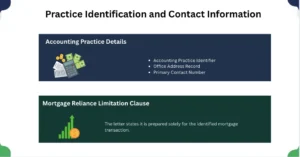
Practice Identification and Contact Information
Accounting Practice Details
- Accounting Practice Identifier
- Office Address Record
- Primary Contact Number
- Professional Contact Email
These allow lenders to verify credentials and request clarification.
Reliance, Authorization, and Limitations
Mortgage Reliance Limitation Clause
The letter states it is prepared solely for the identified mortgage transaction.
Authorization and Execution
- Letter Authorization Date
- Accountant Signature Authorization
How Underwriters Use Business Stability Letters
Contextual Risk Assessment
Underwriters use the letter to:
- Evaluate income durability
- Understand concentration and margin risk
- Assess operational continuity
Complement to Income Letters
A stability letter explains the business engine; income letters explain the output. Both are needed for a complete view.
What This Letter Does, and Does Not, Do
What It Does
- Describes business continuity and resilience
- Provides professional context for underwriting
- Supports Non-QM and complex income reviews
What It Does Not
- Verify financial statements
- Predict future performance
- Guarantee mortgage approval
Best Practices for Borrowers
Consistency Across Documents
Ensure stability narratives align with tax returns, bank statements, and applications.
Transparency Over Advocacy
Clear facts reduce follow-ups more than optimistic language.
Best Practices for CPAs
Define Scope and Period Clearly
Limit reliance and avoid open-ended conclusions.
Use Neutral, Evidence-Based Language
Describe what records show, nothing more.




