


Mortgage underwriters don’t just ask how much money a borrower has, they ask where the money came from and how it will be used. When funds originate from multiple sources or are allocated across several purposes, lenders often request a CPA Letter for Mortgage Use of Funds to bring clarity, structure, and professional context to the transaction.
This article explains how CPAs frame source-and-use letters for mortgage approval, what underwriters expect to see, and how this documentation complements a CPA Letter for Mortgage Business Stability when income and business health are also under review.
What Is a CPA Letter Explaining Source and Use of Funds?
A CPA Letter Explaining Source and Use of Funds is a non-attest, explanatory letter prepared at the borrower’s request. Its purpose is to summarize:
- Where mortgage-related funds originated (source)
- How those funds are intended to be applied (use)
- Whether the use aligns with the stated mortgage purpose, based on records reviewed
The letter does not audit bank accounts, certify balances, or approve the loan. Final determinations remain with the lender.
Why Mortgage Lenders Require a Source and Use Letter
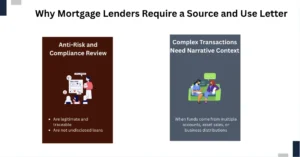
Anti-Risk and Compliance Review
Lenders must confirm that funds:
- Are legitimate and traceable
- Are not undisclosed loans or restricted assets
- Are applied consistently with loan purpose
Complex Transactions Need Narrative Context
When funds come from multiple accounts, asset sales, or business distributions, a CPA letter helps organize the story lenders need to see.
Borrower and Transaction Identification
Borrower Details
A compliant letter typically identifies:
- Borrower Full Legal Name
- Co-Borrower or Secondary Applicant Name (if applicable)
Names must match the mortgage application exactly.
Transaction Reference
To tie the letter to the correct file, it may include:
- Transaction Identification Number (if provided by the lender)
Mortgage Purpose and Property Context
Mortgage Purpose Description
The letter identifies the transaction type, such as:
- Purchase
- Refinance
- Cash-Out
- Other lender-defined purposes
Property Identification
Common references include:
- Property Address or Parcel ID
- Intended Occupancy Type (primary residence, second home, investment)
This context helps lenders assess eligibility and compliance.
Use of Funds Breakdown
Fund Allocation Categories
The letter clearly outlines how funds are intended to be used, such as:
- Down payment
- Closing costs
- Renovation or repairs
- Debt payoff
Amount Requested or Verified
Each category may include an amount requested or verified, based on records reviewed.
Timeline for Fund Usage
Underwriters often want to know when funds will be deployed relative to closing.
Source of Funds Explained
Source of Funds Identification
Common sources include:
- Bank accounts
- Sale of assets
- Gifts
- Other disclosed sources
The CPA describes sources without reclassifying or validating ownership.
Disbursement Method
The letter may note whether funds will be transferred via:
- Wire
- Check
- Internal transfer
This supports lender tracing procedures.
Supporting Documentation Referenced
Documentation Provided
The letter often references review of:
- Bank statements
- Settlement statements
- Asset sale records
Financial Records Examined
- Financial statements or bank records examined are listed at a high level.
No independent verification is implied.
CPA Identification and Engagement Context
Certifying Accountant Information
A lender-acceptable letter includes:
- Certifying Accountant Name
- Professional Designation (CPA)
- License Authority and Region
- License or Certification Number
Engagement Start Date
Some lenders request how long the CPA has worked with the borrower to understand familiarity with records.
Scope, Procedures, and Limitations
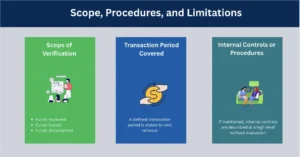
Scope of Verification
The letter clearly defines scope, such as:
- Funds reviewed
- Funds traced
- Funds documented
Transaction Period Covered
A defined transaction period is stated to limit reliance.
Internal Controls or Procedures (Descriptive)
If mentioned, internal controls are described at a high level without evaluation.
Opinion Language (Carefully Limited)
Opinion on Appropriateness of Fund Use
Any opinion is descriptive and limited, framed as:
- Consistency with stated purpose
- Alignment with documentation reviewed
Variance or Exception Statement
If differences or exceptions exist, they may be disclosed factually, without judgment.
Relationship to Business Stability Letters
A CPA Letter for Mortgage Business Stability explains whether the borrower’s business can sustain income and obligations.
A CPA Letter for Mortgage Use of Funds explains how cash is sourced and applied in the transaction.
Together, they address both capacity and application, two pillars of underwriting.
What This Letter Does, and Does Not, Do
What It Does
- Clarifies fund sources and allocations
- Organizes documentation for underwriting
- Supports lender compliance review
What It Does Not
- Audit accounts or transactions
- Certify funds as acceptable
- Guarantee mortgage approval
Best Practices for Borrowers
Keep Funds Clean and Traceable
Avoid last-minute transfers that complicate tracing.
Align With Other Loan Documents
Ensure consistency across disclosures, bank statements, and CPA letters.
Best Practices for CPAs
Define Scope and Purpose Clearly
State what was reviewed, over what period, and for which transaction.
Use Neutral, Factual Language
Avoid assurance-style or approval language.




