

For self-employed borrowers, proving income can be far more complex than handing over a few paystubs. Lenders want reliable evidence of earning capacity, stability, and consistency, yet freelancers, consultants, and business owners are paid in ways that don’t fit traditional employment models. This is where a CPA Letter for Self-Employed borrowers becomes essential.
When prepared correctly and aligned with tax law, the letter can also function as an IRS-Compliant CPA Letter, helping lenders understand income without overstating assurance or stepping outside professional boundaries.
Why Self-Employed Borrowers Face More Scrutiny
Banks and underwriters are trained around W-2 income. Without employer-issued paystubs, they must answer different questions:
- Is the income recurring or one-time?
- How much of the revenue is offset by expenses?
- Does the business generate stable net income year over year?
A CPA letter exists to translate self-employment finances into a format lenders can evaluate responsibly.
What Is a CPA Letter for Self-Employed Borrowers?
A CPA Letter for Self-Employed borrowers is a professional explanation prepared by a licensed CPA that summarizes income based on reviewed financial and tax records. It is written for a specific lender and explains how income is generated, reported, and sustained, without guaranteeing outcomes.
The letter focuses on clarity, structure, and compliance rather than persuasion.
Understanding Business Structure and Income Reporting
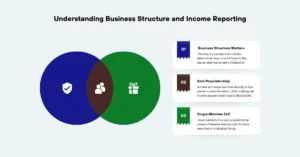
Why Business Structure Matters
The way a business is structured determines how income flows to the owner and how lenders interpret it.
Sole Proprietorship
Income and expenses flow directly to the owner’s personal return, often making net income appear lower due to deductions.
Single-Member LLC
Taxed similarly to a sole proprietorship unless otherwise elected, with income reported on individual filings.
In both cases, lenders rely heavily on CPA explanations to understand sustainability.
Key Information CPAs Review
Business Identification and Legitimacy
A CPA may confirm that the borrower operates an active business, often supported by:
- A business license number
- Length of operation
- Nature of services or products
This establishes legitimacy without certifying business success.
Financial & Tax Information Used
To prepare the letter, CPAs review financial & tax information, typically including:
- Filed tax returns
- Profit and loss statements
- Supporting schedules
These records form the factual basis of the explanation.
Breaking Down Self-Employment Income
Gross Business Receipts vs Net Business Income
Lenders often see strong gross business receipts but lower net business income. This difference is usually driven by deductions.
A CPA explains:
- How revenue is generated
- Why expenses reduce taxable income
- Whether cash flow remains sufficient
Ordinary & Necessary Expenses
Tax law allows deductions for ordinary & necessary expenses, such as:
- Operating costs
- Marketing
- Professional services
These reduce net income on paper but may not weaken real earning capacity.
Owner Add-Backs Explained
In some cases, CPAs explain owner add-backs, expenses that reduce taxable income but do not reflect ongoing cash outflow. While not guaranteed to be accepted by lenders, these explanations provide context.
Partnerships and Multi-Owner Businesses
Income Reported Through Form 1065 and Schedule K-1
For partnerships and multi-owner entities:
- Income is reported on Form 1065
- Each owner receives a Schedule K-1
A CPA letter helps lenders understand how K-1 income translates into actual cash available to the borrower.
IRS Compliance and Professional Boundaries
Why IRS Compliance Is Critical
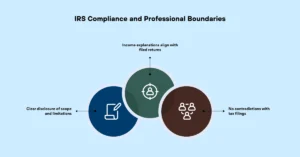
An effective CPA letter for self-employed borrowers must also function as an IRS-Compliant CPA Letter. This means:
- Income explanations align with filed returns
- No contradictions with tax filings
- Clear disclosure of scope and limitations
IRS compliance protects credibility and avoids misrepresentation.
What a CPA Letter Does Not Do
To remain compliant and ethical, the letter clearly states that:
- No audit or assurance was performed
- Income is not guaranteed
- Approval decisions remain with the lender
These boundaries are required, not optional.
How Lenders Use CPA Letters in Underwriting
Lenders use CPA letters to:
- Interpret variable income
- Assess consistency across years
- Reduce uncertainty when paystubs are unavailable
The letter does not replace underwriting, it supports it.
EEAT Perspective: Why CPA Letters Work
From an EEAT standpoint, CPA letters demonstrate:
- Experience in analyzing self-employment income
- Expertise in tax and business reporting
- Authoritativeness through licensed CPA involvement
- Trustworthiness via compliance and transparent disclaimers
This is why lenders continue to rely on them.
Common Situations Where CPA Letters Are Required
Typical Use Cases
- Mortgage and refinance applications
- Business and personal loans
- High-value rental approvals
- Borrowers without W-2 income
In each case, clarity matters more than complexity.




