
An IRS-Compliant CPA Letter is not just a formality, it is a carefully structured professional document designed to align income and expense reporting with U.S. tax law. Whether requested by a lender, landlord, regulator, or legal advisor, this type of CPA Letter exists to explain financial information accurately while remaining fully compliant with Internal Revenue Service rules and professional standards.
Unlike informal explanations, an IRS-compliant letter is shaped by federal tax regulations, ethical obligations, and strict limits on what a CPA can, and cannot, state. Understanding this framework is essential for anyone relying on such a letter for financial decision-making.
What Is an IRS-Compliant CPA Letter?
An IRS-Compliant CPA Letter is a written statement prepared by a licensed CPA that explains income and expense figures as they appear on filed tax returns. Its primary function is alignment, ensuring that financial explanations match tax law, reported filings, and documented records.
The letter does not certify accuracy, guarantee outcomes, or provide audit-level assurance. Instead, it offers professional context grounded in tax compliance.
Why IRS Compliance Matters in CPA Letters
Authority of the Internal Revenue Service
All federal tax reporting ultimately falls under the authority of the Internal Revenue Service. Because CPA letters often rely on filed tax returns, they must reflect how income and expenses are defined, categorized, and allowed under IRS rules.
Any misalignment, even unintentional, can undermine credibility with third parties and expose both the taxpayer and the CPA to risk.
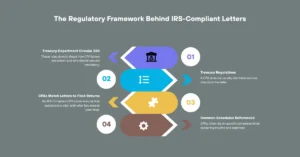
The Regulatory Framework Behind IRS-Compliant Letters
Treasury Department Circular 230
Under Treasury Department Circular 230, CPAs are required to:
- Avoid misleading or incomplete statements
- Clearly state reliance on taxpayer-provided information
- Disclose limitations and scope
These rules directly shape how CPA letters are written and why disclaimers are mandatory.
Treasury Regulations and IRS Guidance
CPA letters are influenced by multiple layers of IRS guidance, including:
- Treasury Regulations, which interpret tax statutes
- IRS Revenue Procedures, which explain administrative processes
- IRS Revenue Rulings, which clarify tax treatment in specific scenarios
- IRS Notices, which provide timely guidance on evolving issues
A CPA does not usually cite these sources directly in the letter, but their principles guide classification and explanation.
Aligning Income and Expense Statements With Tax Law
How CPAs Match Letters to Filed Returns
An IRS-Compliant CPA Letter ensures that explanations align with what has already been filed. This includes consistency across:
- Reported income
- Deducted expenses
- Filing status and schedules
Any differences between financial statements and tax returns must be clearly explained or avoided altogether.
Role of Tax Schedules in CPA Letters
Common Schedules Referenced
CPAs often rely on specific schedules when explaining income and expenses:
- Schedules A & B – Itemized deductions and interest/dividend income
- Schedule C – Business income and expenses
- Schedule D – Capital gains and losses
- Schedule E – Rental, partnership, and pass-through income
- Schedule SE – Self-employment tax
These schedules provide the foundation for income and expense explanations.
Professional Identification and Accountability
Preparer Tax Identification Number (PTIN)
Every CPA involved in tax preparation holds a Preparer Tax Identification Number, which ties their work to professional accountability. While a CPA letter is not a tax filing, the CPA’s professional obligations remain the same.
Authorization and Proper Use of IRS Information
Taxpayer Authorization Statement
A CPA relies on a taxpayer authorization statement to review and reference tax information. Without proper authorization, the CPA cannot access or discuss protected tax data.
IRS Matter Reference and Limited Use
CPA letters often include an IRS matter reference or usage limitation, stating:
- The intended recipient
- The specific purpose
- That the letter should not be reused
This prevents misuse or misinterpretation.
What an IRS-Compliant CPA Letter Does Not Do
No Audit or Assurance
An IRS-compliant CPA letter does not constitute an audit or review. It does not:
- Verify every transaction
- Certify completeness
- Predict future tax outcomes
No Protection From Penalties
A CPA letter does not shield a taxpayer from IRS action or pay penalties. Compliance depends on accurate filing, not explanatory letters.
Why Disclaimers Are Essential
Disclaimers clarify that:
- The CPA relied on provided and filed information
- No assurance engagement was performed
- The letter does not affect IRS audit risk
These statements are required to remain compliant with Circular 230 and professional ethics.
EEAT Perspective: Why IRS-Compliant Letters Build Trust
From an EEAT standpoint, IRS-compliant CPA letters demonstrate:
- Experience in interpreting tax filings
- Expertise in federal tax rules
- Authoritativeness through licensed CPA standards
- Trustworthiness via transparent scope and limitations
This combination makes them credible to lenders, landlords, and regulators alike.
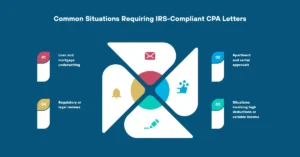
Common Situations Requiring IRS-Compliant CPA Letters
Typical Use Cases
- Loan and mortgage underwriting
- Apartment and rental approvals
- Regulatory or legal reviews
- Situations involving high deductions or variable income
In each case, alignment with tax law is non-negotiable.