


For self-employed borrowers, mortgage underwriting often raises questions that standard documents don’t fully answer. In response, lenders sometimes ask for a CPA Comfort Letter for Self-Employed borrowers. While commonly requested, comfort letters are also frequently misunderstood, by borrowers, lenders, and sometimes even practitioners.
This article explains what a CPA comfort letter is, what it can and cannot say, and why lenders treat it cautiously, especially when business funds are involved. It also clarifies how a comfort letter differs from more targeted documentation such as a CPA Letter for Use of Business Funds Self-Employed.
What Is a CPA Comfort Letter for Self-Employed Borrowers?
A CPA comfort letter is a non-attest, limited-scope letter issued at the borrower’s request. Its role is to provide general, negative-assurance–style comfort based on the CPA’s familiarity with the client and records previously prepared or reviewed.
The letter is not designed to:
- Verify income
- Validate bank balances
- Confirm business stability
- Approve mortgage qualification
Instead, it offers context, nothing more.
Why Lenders Request Comfort Letters
When Documentation Leaves Gaps
Lenders may request a comfort letter when:
- Income is non-traditional or variable
- Business structures are complex
- Fund movements require explanation
Professional Perspective Without Verification
A comfort letter allows lenders to receive professional commentary without placing verification or assurance responsibility on the CPA.
CPA & Borrower Relationship Context
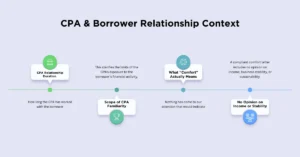
CPA Relationship Duration with Borrower
Comfort letters often disclose:
- How long the CPA has worked with the borrower
This establishes familiarity, not assurance.
Scope of CPA Familiarity
The letter may describe whether the CPA’s role includes:
- Tax preparation
- Ongoing accounting services
This clarifies the limits of the CPA’s exposure to the borrower’s financial activity.
Level of Comfort Provided
What “Comfort” Actually Means
Comfort is typically expressed using language such as:
- “Based on the information provided…”
- “Nothing has come to our attention that would indicate…”
This is negative assurance, not confirmation.
No Opinion on Income or Stability
A compliant comfort letter includes no opinion on income, business stability, or sustainability.
Information Sources and Reliance
Information Source Reliance
The letter clearly states that all information referenced is:
- Provided by the borrower
- Derived from previously prepared records
No Verification or Validation Performed
A core element of the letter is an explicit statement that:
- No independent verification or validation was performed
This protects both the CPA and the lender.
Assurance and Attestation Limits
No Assurance or Attestation Provided
The letter explicitly states:
- No audit, review, or attestation was conducted
No Guarantee of Future Performance
Comfort letters never guarantee:
- Future income
- Ongoing business success
- Mortgage approval
Intended Use and Lender Reliance
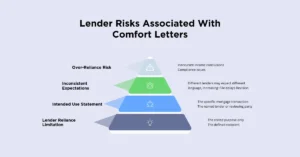
Intended Use Statement
A proper comfort letter includes a clear intended use statement, specifying:
- The specific mortgage transaction
- The named lender or reviewing party
Lender Reliance Limitation
The letter restricts reliance to:
- The stated purpose only
- The defined recipient
This prevents reuse or misinterpretation.
Comfort Letter vs. Use-of-Funds Letter
Key Differences
A CPA Comfort Letter for Self-Employed:
- Provides limited, general comfort
- Uses negative-assurance language
- Avoids transaction-specific conclusions
A CPA Letter for Use of Business Funds Self-Employed:
- Explains where business funds come from
- Describes how they are used
- Addresses liquidity and operational impact
Why Lenders Prefer Specific Letters
Lenders often prefer use-of-funds letters because they are:
- Narrower in scope
- More directly tied to underwriting questions
- Less risky from a reliance standpoint
Lender Risks Associated With Comfort Letters
Over-Reliance Risk
If a comfort letter is misinterpreted as verification, lenders risk:
- Inaccurate income conclusions
- Compliance issues
Inconsistent Expectations
Different lenders may expect different language, increasing:
- File delays
- Revision requests
What the Comfort Letter Covers, and What It Does Not
What It Covers
- CPA’s general familiarity with the borrower
- Information sources relied upon
- Defined scope and limitations
What It Does Not Do
- Verify income or assets
- Assess business viability
- Replace lender underwriting
Borrower Considerations
Request the Right Letter
Borrowers should understand that comfort letters are not substitutes for income or fund verification.
Expect Conservative Language
Overly strong language will be rejected by CPAs and lenders alike.
Professional Considerations for CPAs
Protect the Scope
Always define:
- Relationship duration
- Information sources
- Explicit exclusions
Avoid Underwriting Language
Never imply approval, sufficiency, or certainty.




