


For self-employed borrowers, mortgage underwriting goes far beyond total revenue. Lenders want to understand how much of that revenue is consumed by expenses and whether the remaining income is stable enough to support a mortgage obligation. This is where a CPA Letter for Self-Employed Expense Ratio becomes a critical supporting document.
This article explains how lenders interpret expense ratios, what a CPA expense ratio letter typically includes, and how it complements a CPA Letter for Self-Employed Business Stability, all while remaining clearly non-attest and compliant with professional standards.
What Is a CPA Expense Ratio Letter for Self-Employed Borrowers?
A CPA Expense Ratio Letter is a non-attest, explanatory letter prepared at the borrower’s request. Its purpose is to describe the relationship between a business’s revenue and expenses over a defined period so lenders can better evaluate income quality.
The letter:
- Explains how the expense ratio is calculated
- Describes consistency and reasonableness of expenses
- Provides context for net income trends
It does not verify financial records, audit statements, or determine qualifying income.
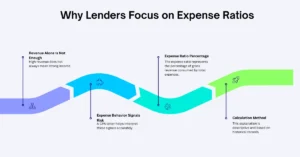
Why Lenders Focus on Expense Ratios
Revenue Alone Is Not Enough
High revenue does not always mean strong income. A business with high operating costs may leave little income available for personal obligations like a mortgage.
Expense Behavior Signals Risk
Lenders use expense ratios to assess:
- Operational efficiency
- Cost control discipline
- Sensitivity to revenue changes
A CPA letter helps interpret these signals accurately.
Understanding the Expense Ratio
Expense Ratio Percentage
The expense ratio represents the percentage of gross revenue consumed by total expenses.
Calculation Method
The CPA letter typically describes the calculation method as:
- Total expenses ÷ gross revenue
This explanation is descriptive and based on historical records.
Period Reviewed
The letter clearly states the period reviewed, such as one or more prior tax years or a trailing twelve-month period.
Revenue and Expense Components
Gross Revenue
The letter references gross revenue as the starting point for analysis, based on financial records reviewed.
Total Expenses
Total expenses are described at a high level, without line-by-line verification.
Fixed vs Variable Expenses
Where helpful, the CPA may explain the difference between:
- Fixed expenses (rent, insurance)
- Variable expenses (materials, commissions)
This helps lenders understand scalability and risk.
Expense Consistency and Patterns
Expense Consistency
Lenders look for consistency in expense ratios over time. The CPA letter may describe whether expenses appear stable, increasing, or variable across periods.
Relationship to Revenue
The letter may note whether expenses scale proportionately with revenue or fluctuate independently.
Industry Context and Reasonableness
Industry Reasonableness
Expense ratios are often evaluated relative to industry norms. The CPA letter may provide general industry context without benchmarking or validation.
Business Model Considerations
Different industries naturally carry different cost structures, which the letter may explain descriptively.
Net Income Impact
Effect on Net Income
The CPA letter explains how the expense ratio impacts net income, helping lenders understand income sustainability.
Sensitivity to Change
If expenses rise or revenue falls, higher expense ratios may signal increased risk, context the CPA can explain historically.
CPA Judgment and Professional Framing
CPA Judgment Statement
Any CPA judgment statement is carefully worded to reflect professional observation—not assurance or prediction.
No Assurance Language
The letter clearly states that no audit, review, or assurance was performed.
Audit Disclaimer and Scope Limitations
Audit Disclaimer
A standard audit disclaimer clarifies that:
- Records were not audited or independently verified
- Information relies on client-provided data
Defined Scope
The scope of review and period covered are clearly defined to prevent overreliance.
How Lenders Use the Expense Ratio Letter
Income Quality Assessment
Lenders use the letter to:
- Assess efficiency and sustainability
- Understand expense-driven income volatility
- Contextualize net income trends
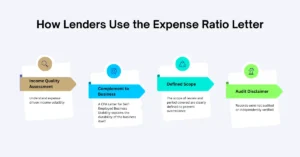
Complement to Business Stability Analysis
A CPA Letter for Self-Employed Business Stability explains the durability of the business itself.
An expense ratio letter explains how efficiently that business converts revenue into income. Together, they provide a fuller underwriting picture.
What the Letter Covers, and What It Does Not
What It Covers
- Expense ratio calculation method
- Historical expense consistency
- Relationship between expenses and income
What It Does Not Do
- Verify expense accuracy
- Approve income for lending
- Guarantee mortgage approval
Borrower Preparation Tips for Underwriting
Maintain Clear Expense Records
Consistent bookkeeping supports clearer expense ratio explanations.
Avoid Last-Minute Changes
Sudden expense spikes near application time often raise questions.
Best Practices for CPAs
Stick to Historical Facts
Describe what the records show, avoid forecasting or underwriting conclusions.
Use Neutral, Professional Language
Avoid phrases that imply assurance, approval, or certification.




