


For self-employed borrowers, mortgage underwriting is rarely just about income. Lenders also want confidence that the business generating that income is stable, sustainable, and resilient over time. This is where a CPA Letter for Self-Employed Business Stability becomes an important supporting document.
This article explains what a business-stability CPA letter is, how lenders use it, and how it differs from income-focused documentation, while remaining compliant, professional, and clearly non-attest in nature. It also shows how this letter fits into the broader framework of a CPA letter for self employed borrowers.
What Is a CPA Letter Explaining Business Stability?
A CPA Letter Explaining Business Stability is a non-attest, explanatory letter prepared at the request of a self-employed borrower. Its purpose is to describe whether a business appears operationally stable based on historical financial patterns and business characteristics.
The letter:
- Describes business continuity and operating history
- Explains revenue behavior and expense structure
- Provides professional context without prediction or assurance
It does not audit financial statements, verify results, or guarantee future performance.
Why Lenders Care About Business Stability
Income Depends on the Business
For self-employed borrowers, income is inseparable from the business. Even strong historical earnings may be viewed as risky if the business lacks stability.
Risk Assessment Beyond Numbers
Underwriters look beyond totals to understand:
- How long the business has operated
- Whether revenue is repeatable
- Whether expenses are controlled
A CPA letter helps frame these factors clearly.
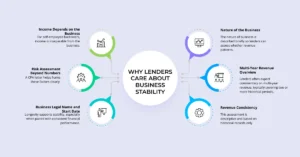
Business Identification and Background
Business Legal Name and Start Date
A compliant letter clearly identifies:
- Business legal name
- Business start date
Longevity supports stability, especially when paired with consistent financial performance.
Nature of the Business
The nature of business is described briefly so lenders can assess whether revenue patterns align with the industry and business model.
Revenue History and Continuity
Multi-Year Revenue Overview
Lenders often expect commentary on multi-year revenue, typically covering two or more historical periods.
Revenue Consistency
The letter may describe whether revenue appears:
- Stable
- Increasing
- Variable
This assessment is descriptive and based on historical records only.
Client Concentration and Diversification
Revenue Concentration Risk
High reliance on a single client can increase risk. The letter may address revenue concentration risk at a high level.
Client Diversification
Where applicable, the letter may note client diversification as a stabilizing factor.
Client Concentration Disclosure
Any material concentration is disclosed factually, without judgment or speculation.
Expense Behavior and Cost Structure
Expense Stability
Lenders want to see whether expenses are predictable. The letter may comment on expense stability over time.
Relationship Between Revenue and Expenses
Descriptive commentary may explain whether expenses scale reasonably with revenue.
Industry and Market Context
Industry Stability
The letter may reference industry stability to contextualize revenue patterns, especially for cyclical or seasonal businesses.
This is provided as background context, not a market forecast.
CPA Professional Commentary
CPA Professional Opinion (Limited)
Any CPA professional opinion is carefully framed as:
- Observational
- Based on historical information
- Non-predictive
Language avoids assurance, guarantees, or forward-looking conclusions.
Records Reviewed and Scope
Financial Information Considered
The letter typically references:
- Tax returns
- Financial statements
- Internal accounting records
These are reviewed at a high level.
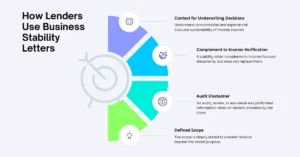
Defined Scope
The scope is clearly stated to prevent reliance beyond the stated purpose.
Audit and Assurance Limitations
Audit Disclaimer
A clear audit disclaimer is included, stating that:
- No audit, review, or assurance was performed
- Information relies on records provided by the client
This protects both the CPA and the lender.
How Lenders Use Business Stability Letters
Context for Underwriting Decisions
Lenders use the letter to:
- Assess business continuity
- Understand concentration and expense risk
- Evaluate sustainability of income sources
Complement to Income Verification
A stability letter complements income-focused documents, but does not replace them.
What the Letter Covers, and What It Does Not
What It Covers
- Historical revenue patterns
- Client concentration and diversification
- Expense behavior and industry context
What It Does Not Do
- Predict future business success
- Verify financial accuracy
- Guarantee mortgage approval
Best Practices for Borrowers
Be Transparent
Disclosing concentration or variability upfront reduces lender concerns.
Keep Documentation Consistent
Ensure the CPA letter aligns with tax returns and loan disclosures.
Best Practices for CPAs
Use Neutral, Evidence-Based Language
Stick to what records show, avoid opinionated or promotional wording.
Define Limits Clearly
Clear scope and disclaimers prevent misinterpretation.




