


Conventional mortgages follow a different rulebook than FHA or Non-QM loans, especially when the borrower is self-employed. Income must meet agency standards, trends must be explainable, and documentation must align cleanly with underwriting models. That’s why lenders often request a CPA Letter for Self-Employed Conventional Loan when tax returns alone don’t tell the full story.
This article explains how CPA letters are used in conventional underwriting, what Fannie Mae and Freddie Mac expect, and how these letters differ from a CPA Letter for Self-Employed FHA Loan, all while staying within non-attest, EEAT-compliant boundaries.
What Is a CPA Letter for Self-Employed Conventional Loans?
A CPA Letter for Self-Employed Conventional Loan is a non-attest explanatory letter prepared at the borrower’s request to help lenders interpret self-employment income under agency guidelines.
The letter:
- Provides context around income history and trends
- Summarizes records reviewed and periods covered
- Does not verify income, audit records, or guarantee approval
Final income qualification and approval decisions remain solely with the lender and its automated or manual underwriting process.
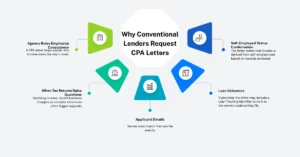
Why Conventional Lenders Request CPA Letters
Agency Rules Emphasize Consistency
Conventional underwriting focuses heavily on:
- Two-year income history
- Direction and stability of earnings
- Alignment with tax returns and schedules
A CPA letter helps explain why income looks the way it does.
When Tax Returns Raise Questions
Declining income, recent business changes, or complex structures often trigger requests for additional professional explanation.
Borrower and Loan Identification
Applicant Details
A compliant letter identifies:
- Conventional Loan Applicant Name
- Secondary Applicant Reference (if applicable)
Names must match the loan file exactly.
Loan Reference
If provided, the letter may include a Loan Tracking Identifier to tie it to the correct underwriting file.
Conventional Transaction Context
Purpose of the Loan
The letter references the Conventional Transaction Purpose, such as:
- Home purchase
- Rate-term refinance
- Cash-out refinance
This provides underwriting context only.
Self-Employment and Business Legitimacy
Self-Employed Status Confirmation
The letter states that income is derived from self-employment based on records reviewed.
Business Registration and Structure
Where applicable, it references:
- Enterprise Registration Title
- State Filing Identifier
- Organizational Classification (sole proprietor, LLC, S-Corp, partnership)
Operational History
- Commencement of Operations Date
- Commercial Activity Location
Longevity supports income reliability under agency rules.
Qualifying Income Framework (Descriptive Only)
Conventional Qualifying Income Basis
The CPA does not calculate qualifying income but may describe how income is derived from historical records.
Two-Year Income History Indicator
Agency underwriting typically relies on:
- At least two prior years of self-employment income
Average Earnings Calculation
If mentioned, averages are historical summaries, not underwriting determinations.
Income Trends and Direction
Income Trend Direction Statement
The letter may describe whether income appears:
- Stable
- Increasing
- Declining
This is descriptive and based on tax periods reviewed.
Ongoing Income Expectancy Opinion
Any commentary is informational, grounded in past performance, not a prediction or assurance.
Agency Standards and Compliance Context
Agency Underwriting Standard
The letter may reference alignment with FNMA / FHLMC standards at a high level.
Self-Employment Eligibility Confirmation
The CPA may state that income meets basic self-employment definition requirements, without interpreting agency rules.
Guideline Compliance Representation
This is framed as contextual, not authoritative.
CPA Identification and Professional Standing
Evaluating CPA Information
A lender-acceptable letter includes:
- Evaluating CPA Name
- Active License Verification
- Credential Issuance Authority
- CPA Identification Code
Client Relationship
- Length of Client Engagement may be disclosed to show familiarity with records.
Scope of Review and Records Considered
Review Method Description
The letter clearly states that the CPA performed a review of client-provided information, not an audit or verification.
Tax Return Periods Reviewed
Typically includes:
- Two most recent tax years
Interim Financial Data
If applicable, the letter may reference year-to-date data.
Supporting Schedules Examined
Examples include:
- Schedule C
- K-1s
- Business returns
Referenced descriptively only.
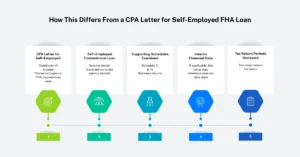
How This Differs From a CPA Letter for Self-Employed FHA Loan
A CPA Letter for Self-Employed FHA Loan emphasizes:
- Continuity of income
- Owner-occupancy
- FHA insured-loan rules
A CPA Letter for Self-Employed Conventional Loan focuses more on:
- Income trends
- Consistency under agency models
- Alignment with FNMA/FHLMC standards
Both are non-attest, but the underwriting lens differs.
What the Letter Does, and Does Not, Do
What It Does
- Explains income history and trends
- Provides professional context for agency underwriting
- Reduces lender follow-up questions
What It Does Not
- Verify income accuracy
- Predict future earnings
- Guarantee mortgage approval
Best Practices for Borrowers
Consistency Is Critical
Ensure CPA letter details align with:
- Tax returns
- Loan application
- Underwriting disclosures
Avoid Overreaching Requests
Agency lenders will reject letters implying guarantees or income approval.
Best Practices for CPAs
Define Scope Precisely
Clearly state:
- Period reviewed
- Records referenced
- Reliance limitations
Use Agency-Appropriate Language
Stick to neutral, factual descriptions aligned with conventional underwriting expectations.




