

FHA financing is one of the most accessible mortgage options for self-employed borrowers, but it also comes with specific documentation expectations. When income is derived from a business or independent work, lenders often request a CPA Letter for Self-Employed FHA Loan to help interpret income history, continuity, and reasonableness under FHA rules.
This guide explains what FHA lenders expect, how a CPA letter supports underwriting, and how it differs from a general CPA Letter for Self-Employed Mortgage, all while staying compliant with non-attest standards and EEAT best practices.
What Is a CPA Letter for Self-Employed FHA Loan?
A CPA Letter for Self-Employed FHA Loan is a non-attest, explanatory letter prepared at the borrower’s request. Its purpose is to provide professional context around self-employment income already reported in tax filings and accounting records so FHA underwriters can assess eligibility and risk.
The letter:
- Explains income structure and continuity
- Summarizes records reviewed and periods covered
- Does not verify income, audit records, or guarantee approval
Final qualifying income and approval decisions always remain with the FHA-approved lender.
Why FHA Has Specific Documentation Rules for Self-Employed Borrowers
FHA loans are insured by the Federal Housing Administration, which requires lenders to apply consistent, risk-focused underwriting standards.
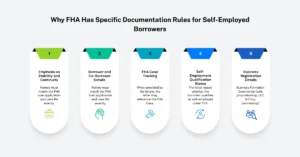
Emphasis on Stability and Continuity
For self-employed borrowers, FHA underwriting focuses on:
- Length of self-employment
- Consistency of income
- Reasonableness relative to the borrower’s profession
A CPA letter helps lenders understand these factors without shifting responsibility away from underwriting.
FHA Applicant Identification
Borrower and Co-Borrower Details
A compliant letter identifies:
- FHA Applicant Legal Name
- Additional FHA Applicant Identifier (if applicable)
Names must match the FHA loan application and case file exactly.
FHA Case Tracking
When provided by the lender, the letter may reference the FHA Case Tracking Reference to tie the letter to the correct file.
Self-Employment Qualification and Business Legitimacy
Self-Employment Qualification Status
The letter states whether the borrower qualifies as self-employed under FHA definitions.
Business Registration Details
Where applicable, the letter references:
- Registered Enterprise Name
- Commercial License Identifier
- Business Formation Description (sole proprietorship, LLC, S-Corp, partnership)
Operational Start Confirmation
- Operational Start Confirmation and business longevity support income continuity analysis.
Business Location and Operations
Primary Operating Address
Identifying the Primary Operating Address helps establish legitimacy and ongoing operations.
FHA Income Evaluation Framework
Qualifying Income Determination Method
The letter describes, at a high level, how income is derived from historical records, without calculating qualifying income.
Historical Income Acceptance Period
FHA lenders typically review:
- Two years of self-employment income, when available
Average Monthly Income Measure
If referenced, averages are descriptive only and based on historical filings.
Income Continuity and Stability
Income Continuity Confirmation
The letter may state whether income appears continuous based on records reviewed.
Anticipated Income Stability Statement
Any stability language is informational, grounded in historical patterns, not a forecast or guarantee.
Occupancy and FHA Eligibility Statements
Owner-Occupancy Attestation
FHA loans require owner occupancy. The letter may acknowledge this requirement based on borrower representations.
Principal Residence Certification
This reinforces FHA eligibility context but does not replace lender verification.
FHA Guideline Reference Indicator
The letter may reference FHA guidelines at a high level to frame context, without interpreting or enforcing them.
CPA Identification and Professional Standing
Reviewing CPA Information
A lender-acceptable letter includes:
- Reviewing CPA Full Name
- Professional Certification Status
- State Board of Accountancy
- CPA Registration Number
Client Relationship Context
- Duration of Client Representation may be disclosed to show familiarity with records.
Scope of Review and Records Considered
Scope of Financial Examination
The letter clearly defines scope as a review of client-provided records, not an audit or verification.
Tax Filing Years Considered
Commonly includes:
- Most recent tax filing years
Interim Coverage
If applicable, the letter may reference an Interim Financial Coverage Period (e.g., year-to-date).
Income Reasonableness and Documentation
Income Reasonableness Opinion
The CPA may describe whether income appears reasonable for the borrower’s role and industry, descriptively only.
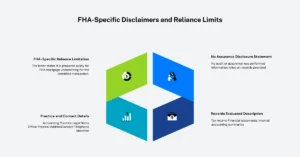
Records Evaluated Description
Typical records referenced include:
- Tax returns
- Financial statements
- Internal accounting summaries
No independent verification is implied.
Accounting Firm Identification
Practice and Contact Details
A compliant letter includes:
- Accounting Practice Legal Name
- Office Physical Address
- Contact Telephone Identifier
- Professional Email Address
These allow lenders to verify credentials or request clarification.
FHA-Specific Disclaimers and Reliance Limits
FHA-Specific Reliance Limitation
The letter states it is prepared solely for FHA mortgage underwriting for the identified transaction.
No Assurance Disclosure Statement
Clear language confirms:
- No audit or assurance was performed
- Information relies on records provided
- The letter does not guarantee approval
How This Differs From a General CPA Letter for Self-Employed Mortgage
A CPA Letter for Self-Employed Mortgage may apply broadly to different loan programs.
A CPA Letter for Self-Employed FHA Loan is tailored to FHA’s emphasis on continuity, owner occupancy, and insured-loan risk controls.
What the Letter Does, and Does Not, Do
What It Does
- Provides FHA-specific income context
- Explains self-employment continuity
- Supports lender underwriting review
What It Does Not
- Verify income accuracy
- Predict future earnings
- Replace FHA lender underwriting
Best Practices for Borrowers
Align All Documents
Ensure the CPA letter matches tax returns, FHA application data, and business records.
Avoid Overreaching Requests
FHA lenders will reject letters that imply guarantees or approvals.
Best Practices for CPAs
Use FHA-Appropriate Language
Stick to historical facts, defined periods, and descriptive observations.
Define Scope Clearly
Clear scope and disclaimers reduce follow-up and protect all parties.




